Employers hoping for some relief from several years of rising healthcare costs may need to reset expectations for 2027.
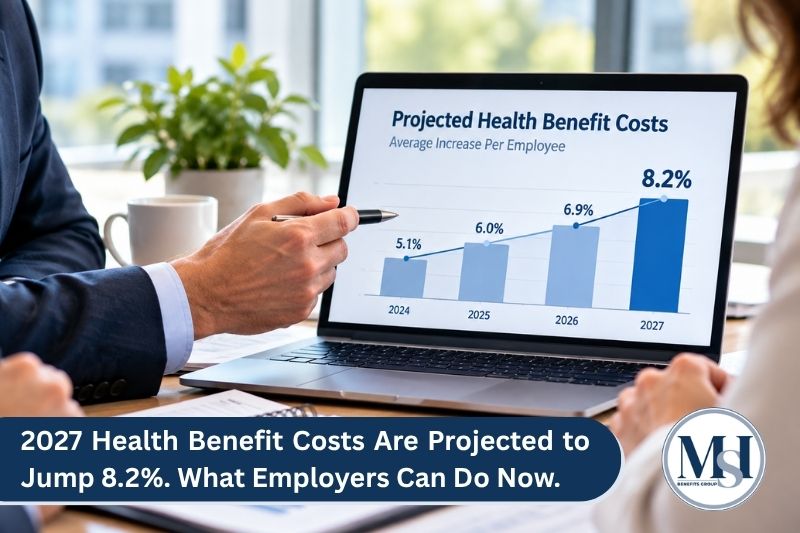
New survey data from Marsh projects that the average total health benefit cost per employee will rise 8.2% in 2027, even after employers make planned changes intended to control spending.
That would be the largest increase since 2003.
But there is another number in the survey that may be even more important for employers: 11%.
That is how much respondents said the cost of their current health plans could increase, on average, if they took no action to reduce costs.
The difference between those two numbers tells an important story.
Healthcare inflation may be largely outside an employer’s control. How an organization prepares for it is not.
Why Costs Are Still Climbing
There is no single culprit behind the projected increase.
Some of the pressure comes from familiar sources. New diagnostic tools and treatments can improve outcomes, but they often cost more than the therapies they replace. Consolidation among hospitals and physician groups can also increase provider negotiating leverage and contribute to higher prices.
At the same time, several newer pressures are becoming significant enough to move overall healthcare trend.
GLP-1 medications are one example. Marsh actuaries estimate that increased utilization of GLP-1 drugs for weight management alone could account for roughly one percentage point of projected 2027 cost growth.
The survey also points to increased claims associated with AI-enabled physician billing technology and higher-than-expected costs associated with the Independent Dispute Resolution process created by the No Surprises Act.
Then there are the high-cost claims employers have already been watching: cancer treatment, specialty medications, complex hospitalizations, cell and gene therapies and treatment for rare diseases.
None of these pressures exists in isolation. Together, they create a healthcare environment in which simply renewing the existing plan and hoping for a better year is becoming increasingly difficult.
The Answer Cannot Always Be Shifting More Cost to Employees
When healthcare costs increase sharply, one of the quickest responses is also one of the most familiar: increase deductibles, contributions, copays or other employee cost-sharing.
And some employers will do exactly that.
Marsh found that 59% of employers plan to make cost-cutting changes to their health benefits for 2027, including plan design changes that could increase employees’ out-of-pocket expenses.
Cost sharing can certainly be part of a benefits strategy. But repeatedly asking employees to absorb larger portions of healthcare inflation has limits.
At some point, a benefit can remain technically available while becoming increasingly difficult for employees to afford or use.
For employers, that makes the better question more specific: Where is our healthcare money actually going, and which portions of that spending can we influence?
Start With Your Own Data, Not the National Average
An 8.2% projection is useful for understanding the market. It is not a forecast for every individual employer.
One organization may be dealing with rapidly increasing specialty pharmacy utilization. Another may have several ongoing high-cost claimants. Another may be experiencing unusually expensive hospital utilization, poor chronic-condition management or employees receiving routine services in unnecessarily expensive settings.
That is why the first step should be examining the employer’s own experience.
Claims and utilization data can reveal which conditions, providers, facilities, medications and types of care are driving spending. It can also help identify whether those patterns are isolated events or trends likely to continue into the next plan year.
MSI’s Reporting and Analytics capabilities are designed around this kind of analysis, helping employers monitor plan performance, identify cost drivers and use current information to forecast future spending.
The goal is not simply to produce another report.
It is to find the places where action could make a measurable difference.
Look Closely at Pharmacy Before Renewal
Prescription drug spending deserves particular attention heading into 2027.
GLP-1 utilization has grown rapidly, while specialty medications and advanced therapies continue to introduce extraordinarily expensive treatments into employer health plans.
Employers should understand not only what they are spending on pharmacy benefits, but how those dollars are being managed.
That may include reviewing PBM arrangements, rebates and pricing transparency; evaluating specialty pharmacy programs; examining formulary management; identifying biosimilar opportunities when clinically appropriate; and reviewing how expensive medications are sourced and administered.
For some employers, pharmacy strategy may offer substantially more opportunity than another round of across-the-board benefit reductions.
Pay Attention to Where Care Is Delivered
The same medical service can carry dramatically different prices depending on where it is performed.
Imaging, laboratory services, outpatient procedures, infusions and other services may cost considerably more in a hospital-affiliated setting than through another appropriate provider.
That creates an opportunity that does not necessarily require reducing benefits.
Employers can evaluate network design, centers of excellence, site-of-care programs and navigation resources that help employees find high-quality, cost-effective providers.
This is becoming an increasingly important employer strategy. In Marsh’s survey, 58% of large employers identified guiding employees toward higher-quality care as an important or very important priority for managing their health programs over the next few years.
Better care and lower costs do not always conflict. In many situations, they can reinforce each other.
Get Ahead of High-Cost Claims
Large claims can quickly overwhelm savings achieved elsewhere in a health plan.
An employer might negotiate better pharmacy pricing, improve network discounts and make smart plan-design changes, only to see much of those savings erased by one or two extremely expensive claims.
That makes high-cost claim management increasingly important.
Employers should be reviewing emerging claim activity throughout the year rather than waiting for renewal. Specialty medications, ongoing cancer treatment, complex conditions and other large claims may have financial implications that continue well into the next plan year.
For self-funded employers, this analysis should also connect directly to stop-loss strategy.
MSI recently explored these issues in greater detail in Preparing for High-Cost Claims: Strategies That Protect Your Benefits Budget.
Understanding developing risk earlier does not eliminate that risk. It does give employers more time and more options for managing it.
📌 2027 COST OUTLOOK: WHAT EMPLOYERS SHOULD KNOW
8.2%
Projected average increase in total health benefit cost per employee for 2027, after planned cost-management measures.
11%
Projected increase employers say they could face if they made no changes to their current plans.
59%
Employers planning cost-cutting benefit changes for 2027.
58%
Large employers identifying guidance toward higher-quality care as an important or very important health program priority.
The takeaway: An 8.2% national projection does not mean every employer will experience an 8.2% increase. Your own claims, pharmacy utilization, workforce and plan design will determine your actual experience. The time to identify those pressures is before renewal decisions are locked in.
Source: Marsh, 2026 National Survey of Employer-Sponsored Health Plans, preliminary results.
Treat Renewal as the End of the Process, Not the Beginning
One of the most important changes employers can make may have nothing to do with a particular vendor or plan design.
It is timing.
If cost-management conversations begin only when renewal numbers arrive, many of the year’s most important decisions have effectively already been made.
A stronger approach starts earlier.
Claims can be reviewed throughout the year. Pharmacy utilization can be monitored. Emerging high-cost claims can be identified. Network performance can be evaluated. Alternative funding approaches can be modeled. Employee utilization patterns can be studied. Potential solutions can be investigated before an employer is facing a renewal deadline.
This is also where an experienced benefits advisor can help connect pieces that otherwise may be evaluated separately.
MSI’s Benefits Consulting approach combines plan data, financial reporting, funding analysis and ongoing monitoring to help employers evaluate strategies based on their own circumstances rather than relying solely on market averages.
8.2% Is a Forecast, Not a Foregone Conclusion
There is no strategy that can completely insulate an employer from healthcare inflation.
Medical innovation will continue. Expensive therapies will reach the market. Provider pricing will change. Employees will experience serious illnesses and unexpected medical events.
But an employer’s response does not have to begin and end with paying the increase or passing more of it along to employees.
The gap between Marsh’s 11% projected increase without employer action and 8.2% increase after planned cost-management measures is a useful reminder that strategy matters.
The organizations best positioned for 2027 will be the ones asking questions now: What is driving our costs? Which trends are likely to continue? Where are employees receiving care? What is happening in pharmacy? Where do we have unnecessary expense? And which changes could produce meaningful savings without undermining the value of the benefits program?
Those questions are worth answering before the renewal arrives.
Start Planning for 2027 Now
MSI Benefits Group helps employers analyze claims, evaluate healthcare cost drivers, model funding and plan-design alternatives and develop strategies designed around the needs of their workforce.
With another significant increase in employer healthcare costs projected for 2027, waiting for renewal numbers to arrive can leave valuable options on the table.
Contact MSI Benefits Group to begin reviewing your 2027 cost strategy now.